
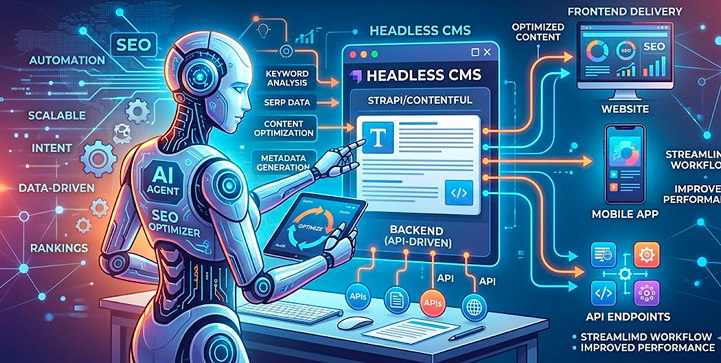
AI SEO agents with headless CMS are transforming how modern teams approach search optimization. Instead of juggling manual updates and scattered tools, businesses now rely on intelligent automation to streamline workflows and improve performance. This shift not only saves time but also ensures consistent optimization across every piece of content.
As SEO becomes more complex, automation plays a critical role in handling data-heavy tasks like keyword analysis, metadata creation, and content updates. When combined with a headless CMS, AI SEO agents can seamlessly push optimizations across multiple platforms, from websites to mobile apps.
Ultimately, AI SEO agents with headless CMS create a scalable system where content stays optimized, up-to-date, and aligned with search intent, without overwhelming your team.
Why automation is becoming essential for SEO teams?
SEO has grown far beyond keyword stuffing and backlinks. Today, it involves technical audits, content optimization, and constant updates. Because of this complexity, automation is no longer optional. It saves time, reduces errors, and allows teams to focus on strategy rather than execution.
How headless CMS platforms enable scalable SEO?
Headless CMS platforms separate the backend from the frontend. This flexibility allows teams to push optimized content across multiple channels—websites, apps, and more—without duplication. As a result, SEO becomes scalable and easier to manage.
What Are AI SEO Agents?
Definition of AI agents in search optimization
AI SEO agents are software systems designed to automate SEO processes. They use machine learning and data analysis to improve content visibility in search engines.
Tasks automated by AI SEO systems
- Keyword clustering: Grouping related keywords based on search intent
- Metadata generation: Creating optimized titles and descriptions
- Internal linking suggestions: Improving site structure and navigation
- Content optimization: Enhancing readability, relevance, and keyword usage
These capabilities allow businesses to execute SEO strategies faster and more effectively.
Why Headless CMS Platforms Need AI SEO Automation?
Decoupled architecture and multi-channel publishing
A headless CMS allows content delivery across multiple platforms. However, managing SEO for each channel manually can be overwhelming. AI automation simplifies this by applying consistent optimization rules everywhere.
Managing SEO at scale across hundreds of pages
Large websites often struggle with maintaining SEO consistency. AI agents solve this by auditing and optimizing pages in bulk, ensuring uniform quality.
Reducing manual optimization workload
Instead of editing every page manually, teams can rely on AI to handle repetitive updates. This reduces workload while maintaining high performance.
Overview of Popular Headless CMS Platforms
Strapi CMS overview and SEO capabilities
Strapi is an open-source headless CMS known for flexibility. It allows developers to customize SEO fields, integrate plugins, and manage structured content efficiently. It allows AI developers to customize SEO fields, integrate plugins, and manage structured content efficiently.
Contentful CMS architecture and content management workflow
Contentful offers a cloud-based solution with powerful APIs. Its modular content structure makes it easy to integrate SEO automation tools and manage large-scale content operations.
Benefits of using headless CMS for SEO-driven websites
- Faster content delivery
- Better scalability
- Easier API integrations
- Consistent SEO across platforms
Architecture of an AI SEO Automation Workflow
Data layer for keyword intelligence and SERP analysis
This layer collects keyword data, search trends, and competitor insights. It forms the foundation for all SEO decisions.
AI agent layer for content optimization recommendations
AI processes the data and generates actionable insights—such as keyword usage, meta improvements, and content gaps.
CMS integration layer using APIs and automation tools
Finally, APIs connect the AI system with your CMS. This allows automatic updates to content fields without manual intervention.
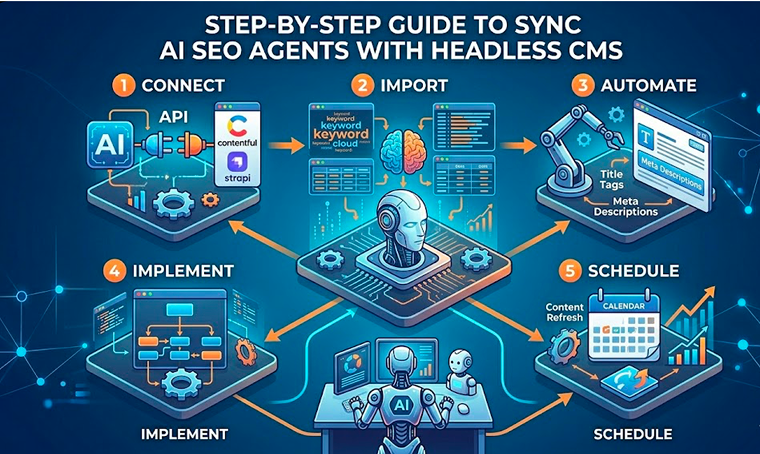
Step-by-Step Guide to Sync AI SEO Agents with Headless CMS
Step 1: Connect headless CMS APIs to your SEO automation system
Start by integrating your CMS APIs with your AI SEO tool. This connection enables seamless data exchange.
Step 2: Import keyword clusters and search intent data
Feed your AI system with structured keyword clusters. This ensures accurate optimization aligned with user intent.
Use AI to generate optimized metadata for every page. This improves click-through rates and visibility.
Step 4: Implement AI-driven internal linking suggestions
AI can identify linking opportunities across your content. This strengthens site structure and improves SEO performance.
Step 5: Schedule automated content refresh triggers
Set triggers to update content based on performance metrics. This keeps your pages relevant and competitive.
Example Workflow: AI Detecting and Fixing SEO Issues
AI identifies pages with declining click-through rates
The system continuously monitors performance data and flags underperforming pages.
Automatic title and meta description optimization
Once identified, AI updates metadata to improve engagement.
Updating CMS content fields through API integrations
Changes are pushed directly into the CMS, ensuring real-time optimization without manual effort.
Benefits of Syncing AI SEO Agents with Headless CMS
Faster SEO optimization cycles
Automation significantly reduces the time needed for updates and improvements.
Scalable content management across large websites
AI enables consistent optimization across hundreds or even thousands of pages.
Improved consistency in metadata and internal linking
Standardized rules ensure uniform quality and better user experience.
Common Challenges and Pitfalls in AI SEO Automation
Over-automation without editorial review
Relying entirely on AI can lead to generic or inaccurate content. Human oversight remains essential.
Poor keyword data feeding the AI models
If your data is flawed, your results will be too. Always validate keyword inputs.
CMS integration errors and workflow conflicts
Improper API setups can disrupt workflows. Testing and monitoring are crucial.
Best Practices for AI-Driven SEO Workflows
Combine human editorial oversight with automation
AI should assist, not replace, human creativity and judgment.
Build structured SEO fields inside the CMS
Create dedicated fields for titles, descriptions, and keywords to streamline automation.
Regularly audit AI-generated optimizations
Frequent audits ensure accuracy and maintain content quality.
Conclusion
Why automation is the future of enterprise SEO
As websites grow, manual SEO becomes unsustainable. Automation ensures efficiency, accuracy, and scalability.
Integrating AI agents into modern CMS ecosystems
By syncing AI SEO agents with headless CMS platforms, businesses can build a powerful, future-ready SEO infrastructure that drives consistent growth.
FAQs
No. While AI can handle many tasks, human input is still needed for strategy and quality control.
Indirectly, yes. It enhances scalability and performance, which contribute to better SEO outcomes.
Both are strong options. Strapi offers flexibility, while Contentful excels in enterprise-level scalability.
Popular tools include SEO automation platforms, API-based AI services, and custom-built integrations.